There is a meeting that happens in every school and university marketing department, usually sometime in October, and it always goes the same way. Someone puts up a slide showing the target audience. On the slide: parents. Age 38 to 52. Professional. Aspirational. Concerned about value for money and career outcomes. The problem is that no one really argues with the slide
Because the person who actually decides where a child studies in India in 202 is not a 45-year-old professional. It is a 16-year-old with a phone, three group chats, opinions about campus culture, and zero interest in your brochure.
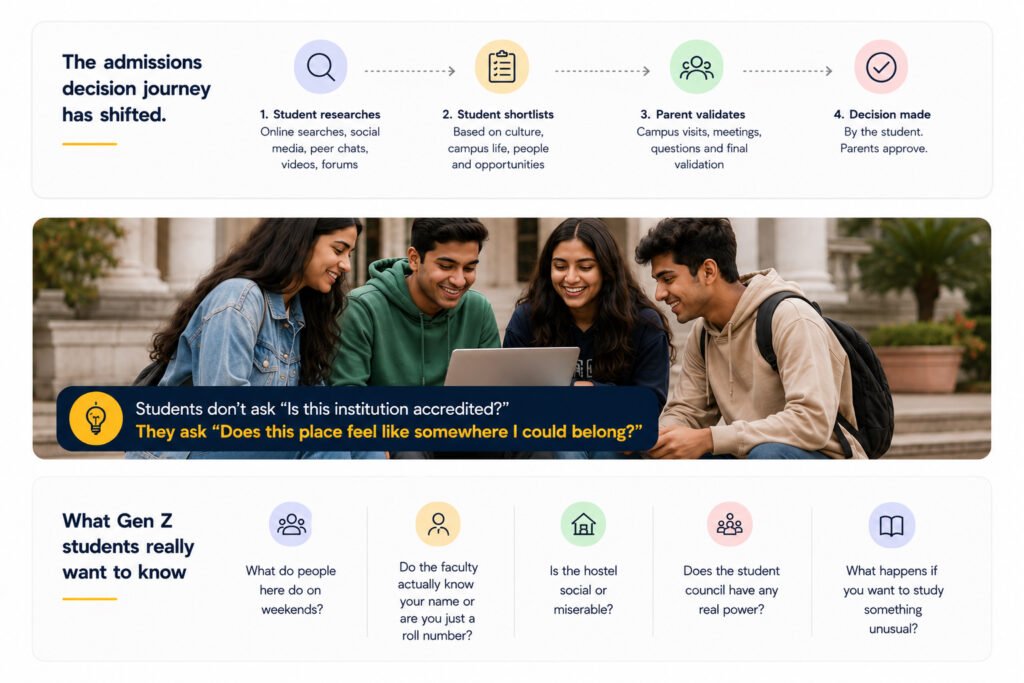
Gen Z students are not asking “is this institution accredited?” They are asking “does this place feel like somewhere I could belong?”
The decision has already shifted
For years, Indian education marketing made a reasonable assumption: parents hold the purse, so parents hold the power. And for a long time, that was mostly true. Parents shortlisted, parents visited campuses, parents asked about placement records. While that model is yet not dead, it is incomplete.
At Edunoia, we are seeing this shift, when we talk to students and parents while conducting on-grounds research, what consistently shows up is that the shortlist is now built by the student. By the time a family visits a campus or attends an open day, the student has already done weeks of research. They have watched YouTube tours, scrolled through Instagram accounts, checked Reddit threads, asked seniors on Discord. The parent arrives to validate a decision the teenager largely made.
So why are most institutions still building campaigns that peak at parent-facing newspaper ads and WhatsApp broadcasts?
Marketing to parents while students scroll past you
Walk through how a typical Indian institution runs its admissions marketing and the mismatch becomes very obvious. The prospectus talks about infrastructure and accreditation, the website leads with the chairman’s message, the social media posts are about award ceremonies and dignitaries cutting ribbons and the open day brochure has a photo of the library.
None of this is wrong. Parents want to know about infrastructure. Accreditations matter. But this content is doing nothing for a 16-year-old trying to work out whether she would feel at home there.
What does a student actually want to know? What do people here do on weekends? Do the faculty actually know your name or are you just a roll number? Is the hostel social or miserable? Does the student council have any real power? What happens if you want to study something unusual?
These are brand questions which unfortunately, most institutions have no good answers to, because they have never thought of students as a separate brand audience
The institution that speaks to the student directly, in language that feels real, will win the shortlist before the parent even enters the picture.
The Gen Z education decision: how it actually works
Gen Z does not consume information the way earlier generations did. They are not reading four-page PDFs. They are not impressed by stock photography of people looking thoughtfully at laptops. They are very good at detecting when content has been made for someone else and deciding it is not for them.
What they respond to is specificity. A current student talking candidly on Instagram stories about what a semester actually looks like. A professor with a personal YouTube channel who seems to have a life outside academia. A campus account that posts something other than event recaps. Student-generated content that was clearly not approved by three committees before it went up. In other words, they respond to things that feel true.
It’s also important to know that institutions cannot fake this. A student can tell within seconds whether a social media account is run by a communications team who has never been inside a classroom or by people who actually love the place. Trust is the only currency that works with this cohort, and trust cannot be manufactured in a campaign.
What this means for how you allocate your brand budget
Most institutions spend the majority of their admissions marketing budget on channels that reach parents: outdoor media, print inserts, radio spots in certain markets, agent commissions, open-day logistics. Some of this has value. But the ratio is wrong.
If the student builds the shortlist, student-facing brand investment should carry more weight than it currently does. What does that look like in practice?
It means funding and actually empowering a student ambassador programme where the students speak authentically, not in approved talking points. It means building a social presence that has a distinct personality rather than a content calendar that ticks boxes. It means making sure that the first thing a prospective student finds when they search your institution’s name is something that makes them want to know more, not a Wikipedia stub and a NAAC certificate.
It also means rethinking the campus visit. Most open days are designed to impress parents. The schedule is full of presentations, infrastructure tours, and Q&A sessions with management. The student is dragged along. Flip this. Design an experience where the student meets current students, attends something that feels like actual college life, and leaves feeling like they have had a genuine glimpse of the place. The parent will form their own impression; give the student a reason to lobby for your institution on the drive home.
The parent is still important. Just not in the way you think.
None of this means ignoring parents. Parent anxiety about their child’s future is real, deep, and worth addressing seriously. But the brand job for parents is different.
For parents, the brand needs to answer one question with conviction: “Is my child going to be okay here?” That encompasses safety, graduate outcomes, faculty quality, financial value, and the sense that the institution has its head on straight. This is trust-building, not feature-listing. A parent who trusts an institution does not need to see every credential; they just need to feel that the place knows what it is doing.
The student needs to feel desire. The parent needs to feel trust. These are two different emotional jobs requiring two different brand approaches. Most institutions conflate them into one generic message that satisfies neither.
Student: Does this place feel like me?
Parent: Will my child be safe and successful here?
One campaign cannot answer both questions. Two distinct brand strategies can.
The institutions getting this right
The ones doing it well in India are the ones that have made a genuine choice about who their brand talks to and how. FLAME University decided early on that it was talking to a particular kind of student, one who was intellectually curious and slightly nonconformist, and it built everything from campus culture to communications around that student. Parents came along because the student was committed.
Several newer universities and EdTech platforms have built strong student communities precisely because they gave students actual ownership of the brand voice. Not complete control, but enough room that the content feels like it comes from inside.
The ones struggling are the ones still running the same parent-facing playbook they ran in 2015, watching yield rates drop and attribution becoming murkier by the year, without quite understanding why
Start here
If you want to fix this, start by doing something uncomfortable. Pull up your institution’s last six months of marketing output and ask honestly: how much of this was made for a 16-year-old, in language and format they actually consume? How much of it would make a teenager feel like your institution sees them, as opposed to their parents’s income bracket?
The answer will tell you more than any admissions data can.
India’s education sector is entering a period where institutional differentiation is going to matter enormously. More institutions are competing for roughly the same pool of students. The ones that win will be the ones that figured out who they were actually talking to.
That conversation starts long before admissions season. And it does not start with a brochure.
Edunoia is India’s first brand consultancy built exclusively for education. We help schools, universities, and EdTech brands find their voice and build identities that work for the students, parents, and institutions of today.